Noida Extension: How It Was Built, and How It Is Different From Noida
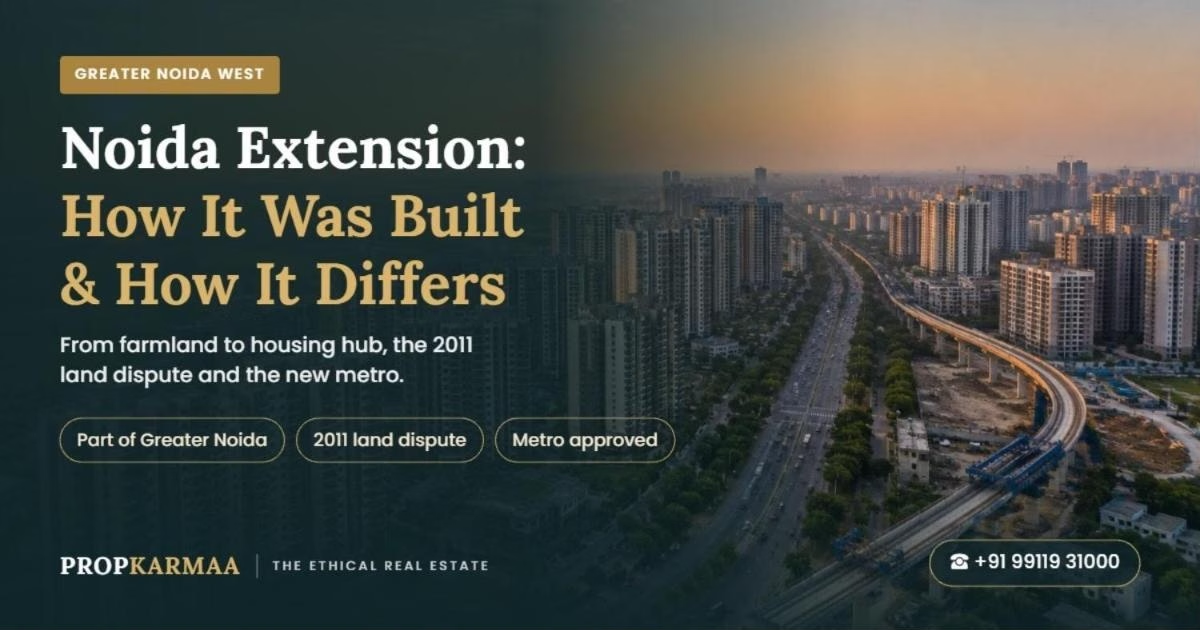
Today, Noida Extension is one of the most talked-about housing markets in Delhi NCR, with tall towers, busy markets and lakhs of residents. But fifteen years ago, most of it was farmland, and for a while it looked like the whole idea might collapse in court. If you are thinking of buying here, it helps to know how this area came to be, why it went through such a rough patch, and how it is actually different from Noida.
First, what exactly is “Noida Extension”?
Here is the surprising part: Noida Extension is not a part of Noida at all. It is a part of Greater Noida. The name was coined by developers because the area sits right next to Noida, and “Noida” was the better-known brand. The Greater Noida Authority later named it officially as Greater Noida West, but most people, brokers and even news reports still call it Noida Extension. It covers roughly 3,600 hectares and begins just a few kilometres from Noida’s Sector 121.
How it began: from villages to a housing hub
Noida came first. The New Okhla Industrial Development Authority (NOIDA) was set up in 1976 to plan an industrial town next to Delhi. As Noida filled up, the UP government created a second authority, the Greater Noida Industrial Development Authority (GNIDA), in 1991 to plan a bigger city further east.
Around 2008–2010, the Greater Noida Authority acquired large areas of farmland in villages such as Shahberi, Patwari, Bisrakh, Itaida, Haibatpur, Rauja, Tusyana, Khairpur and Chauganpur. The land was acquired for “industrial development”, but much of it was then allotted to private builders for housing. Developers launched project after project, and because the land was cheap, flats were priced far below Noida. Within a few years, the area had become Delhi NCR’s biggest affordable housing hub, with reports in 2011 putting the number of apartments under construction at over two lakh.
2011: the year everything stopped
Many farmers felt they had been paid too little, and that land taken for industry should not have been handed to builders for housing. They went to court. In May 2011, the Allahabad High Court cancelled the acquisition of about 156 hectares in Shahberi village, and in July 2011 the Supreme Court upheld that decision. The main reason was that the government had used the “urgency clause” of the land law to skip hearing the farmers, and then changed the land use from industrial to residential.
Thousands of buyers who had booked flats in Shahberi were left stranded, and farmers from other villages filed similar cases. Construction across Noida Extension slowed to a crawl, and buyers did not know whether their projects would survive.
In October 2011, a full bench of the Allahabad High Court gave a middle-path ruling: in most villages, the acquisition was allowed to stand, but farmers had to be paid extra compensation and given developed plots. The Supreme Court later upheld this approach. By September 2012, the Greater Noida Authority restarted development, and work slowly picked up again.
The next problem: delays and registries
The land dispute was settled, but its effects lasted for years. Many projects here were launched by smaller builders at very low prices, and the 2011–12 freeze hurt their finances. Some projects were delayed by years, and many builders fell behind on dues to the Authority. As a result, thousands of buyers who had paid for their flats could not get them registered in their names.
Things have improved a lot since 2023, when the UP government adopted the Amitabh Kant committee’s recommendations for stuck projects, which allowed builders to clear dues in instalments so that registries could go ahead. Most of Noida Extension today is lived-in and settled, but the history explains why checking a project’s paperwork matters even more here.
Noida Extension today
The area has changed beyond recognition. It now has large societies, schools, hospitals, malls and busy local markets, and a big working population that commutes to Noida and Delhi. Its biggest weakness has always been public transport: there is no metro inside Noida Extension yet, so most residents depend on cars and cabs, and the roads towards Noida get heavily jammed at peak hours.
That is now changing. On 11 November 2026, the Union Cabinet approved the extension of the Aqua Line metro from Noida Sector 51 to Greater Noida Sector 4 (Kisan Chowk), an 8.4 km elevated line with five stations and an estimated cost of about ₹2,390 crore. It will also connect with the Delhi Metro’s Blue Line at Sector 61. This is the first phase of the long-awaited metro for Noida Extension, and once built, it will make the daily commute much easier.
Noida vs Noida Extension: the key differences
| Noida | Noida Extension | |
|---|---|---|
| Authority | Noida Authority (set up 1976) | Greater Noida Authority (set up 1991) |
| How old | Developed over 45+ years, mature sectors | Mostly built after 2010, newer area |
| Metro | Blue Line and Aqua Line run through it | No metro yet; first line approved in Nov 2026 |
| Layout | Planned sectors with plotted homes, societies and offices | Mostly high-rise group housing, very dense in parts |
| Jobs nearby | Big office hubs (Sector 62, 125–135, Expressway) | Fewer offices inside; most people commute to Noida |
| Prices | Higher, especially on the Expressway and in central sectors | Usually much lower per sq ft for similar-size flats |
| Who buys | Upgraders, premium and luxury buyers, investors | First-time buyers, young families, value buyers |
| Paperwork history | Fewer disputes, though some projects had dues issues | Land dispute in 2011, followed by delays and registry issues |
In short, Noida gives you maturity, metro and offices nearby at a higher price. Noida Extension gives you more space for your money and newer projects, but with heavier traffic and a history that makes careful checks essential. For current price levels across both, see our Noida flat prices 2026 guide.
Buying in Noida Extension? Check these first
- OC and registry: for a ready flat, confirm the tower has an occupancy certificate and that registries are actually happening.
- Builder’s dues: ask whether the builder has cleared its dues to the Greater Noida Authority, or is paying them on schedule.
- UP RERA: check the project’s registration, promised delivery date and any complaints.
- Daily commute: drive to your office at peak hours once before deciding, and check how far the nearest planned metro station will be.
- Society upkeep: in dense projects, maintenance, water, lifts and parking matter a lot, so talk to residents.
Our take
Noida Extension’s story is one of a rough start and a strong recovery. It grew too fast, was hit hard by the 2011 land dispute, and spent years fixing delays and registries. Today it is a settled, lived-in part of NCR, and the newly approved metro is the missing piece it has waited for. For buyers who want more space within a sensible budget, it deserves a serious look, as long as you choose the project on its paperwork and delivery record, not just its price.
Quick answers
Is Noida Extension part of Noida?
No. It is part of Greater Noida and comes under the Greater Noida Authority. Its official name is Greater Noida West.
Why did Noida Extension projects get stuck in 2011?
Courts cancelled land acquisition in some villages, such as Shahberi, because farmland taken for industry was given to builders for housing without properly hearing farmers. Most other villages were later settled with extra compensation.
Is there a metro in Noida Extension?
Not yet. In November 2026, the Union Cabinet approved an Aqua Line extension from Noida Sector 51 to Greater Noida Sector 4, the first phase of metro connectivity for the area.
Looking at a flat in Noida Extension or Noida? We can help you compare options and check the paperwork before you decide. Call +91 99119 31000.